martes, 29 de marzo de 2011

To Enter La Embajada

 This past Thursday both the MG and Social Work groups headed to Mexico City, aka D.F., aka Distrito Federal. Some of us had been there before as Maren has noted in the previous post, while for others it was the first time back to the capital since arriving to México. We stayed at Casa de los Amigos, a Quaker Center for Peace and International Understanding. We had such a large group that we ate breakfast in two morning shifts on Friday, and then we traveled to la Embajada de Estados Unidos, the U.S. Embassy. In order to enter, we had to bring our passports, wear professional clothing, and leave electronics at the door. We heard from a panel of U.S. employees who have their current tours/posts in México. It’s interesting that ‘tours’ in the foreign service are generally only 2-3 years long. Is this because they don’t want people to become too attached to the country they are working in? Wouldn’t it be better to have experts rather than a shifting staff?
We learned about the visa process, which is long and complicated. Some applicants have been waiting for 15 years just to have their appointment; it isn’t even guaranteed that they will qualify. I further researched online and found that up until January 2010, HIV infection was a reason for ineligibility based on health-related grounds (1). Fortunately this has changed, and HIV positive individuals are not restricted from crossing the border. Later, some of the MG students debriefed the Embassy visit in Abril’s Political Science course. We discussed how only certain individuals in Mexican society have a chance at getting a visa because they must prove that they have ‘enough’ economic resources. This gives insight into why crossing without official documents becomes logical and reasonable for individuals and families under economic pressures.

 Students from the Political Science class at the Cuernavaca sign in Mexico City

Barriers to immigration efforts are not unique to the U.S. At the talk at the Embassy, we learned that a recent survey found that many Mexicans expressed conservative expectations from Latin and Central America immigrants, such as a high level of education and ability to speak Spanish. This reminded me of the film De nadie we watched a few weeks ago about the struggles experienced and challenges faced by immigrants south of Mexico. As the journey to the U.S. from Mexico is not an easy one by any means, the journey through Mexico for a Latin or Central American immigrant can be even more difficult. I would definitely recommend this film, and I would like to present some questions that often come up in our lab group and class discussions: Doesn’t America include the North, Central, and South? Aren’t we all Americans? What is the best way to build respectful and supportive relationships within our American family?

1. 1) U.S. Department of State. Classes of Aliens Ineligible to Receive Visas. Accessed March 20, 2011: < http://travel.state.gov/visa/frvi/ineligibilities/ineligibilities_1364.html#1 >.


-Annica Stull-Lane (Oberlin College ´11)

Learning about Women´s Rights with a visit to CIDHAL

On Thursday March 17th, the Migration and Globalization students visited the first women’s organization in Cuernavaca, Morelos. CIDHAL or Comunicación, Intercambio y Desarrollo Humano en América Latina, is an organization that focuses on women’s rights not only in Cuernavaca but throughout Latin America. They have inspired similar organizations to increase benefits for females, including education, health, communication and information in communities where women are so often marginalized.
Students and Professor Ann Lutterman-Aguilar with
Flor Dessiré León Hernández and Jerry Martínez Águila

Flor Dessiré León Hernández, led a two-hour session that explained the work that CIDHAL does to benefit the community and help women who otherwise would be hopeless. The work accomplished at CIDHAL is inspirational and functions in such a way that comforts many. The mission statement of CIDHAL says it all: “The completion and participation of all kinds of social, cultural, scientific, and educational means to initiate, promote, promote or encourage communication and exchanges for human development in all its aspects in Latin America mainly women, irrespective of any political or religious ideology.”

Throughout the session, we learned about many issues that women face in all parts of the world such as motherhood, sex education, and the hot topic of abortion. It was fascinating to learn about such topics that are often debated in our own cultures but in a different context with many different culture norms involved in greater Mexican society. The trip was rewarding and inspirational to say the very least. For more information on CIDHAL and its work, check out their website at http://www.cidhal.org/.


-Sam Krogstad (University of St. Thomas)

miércoles, 16 de marzo de 2011

Mexico City Experience

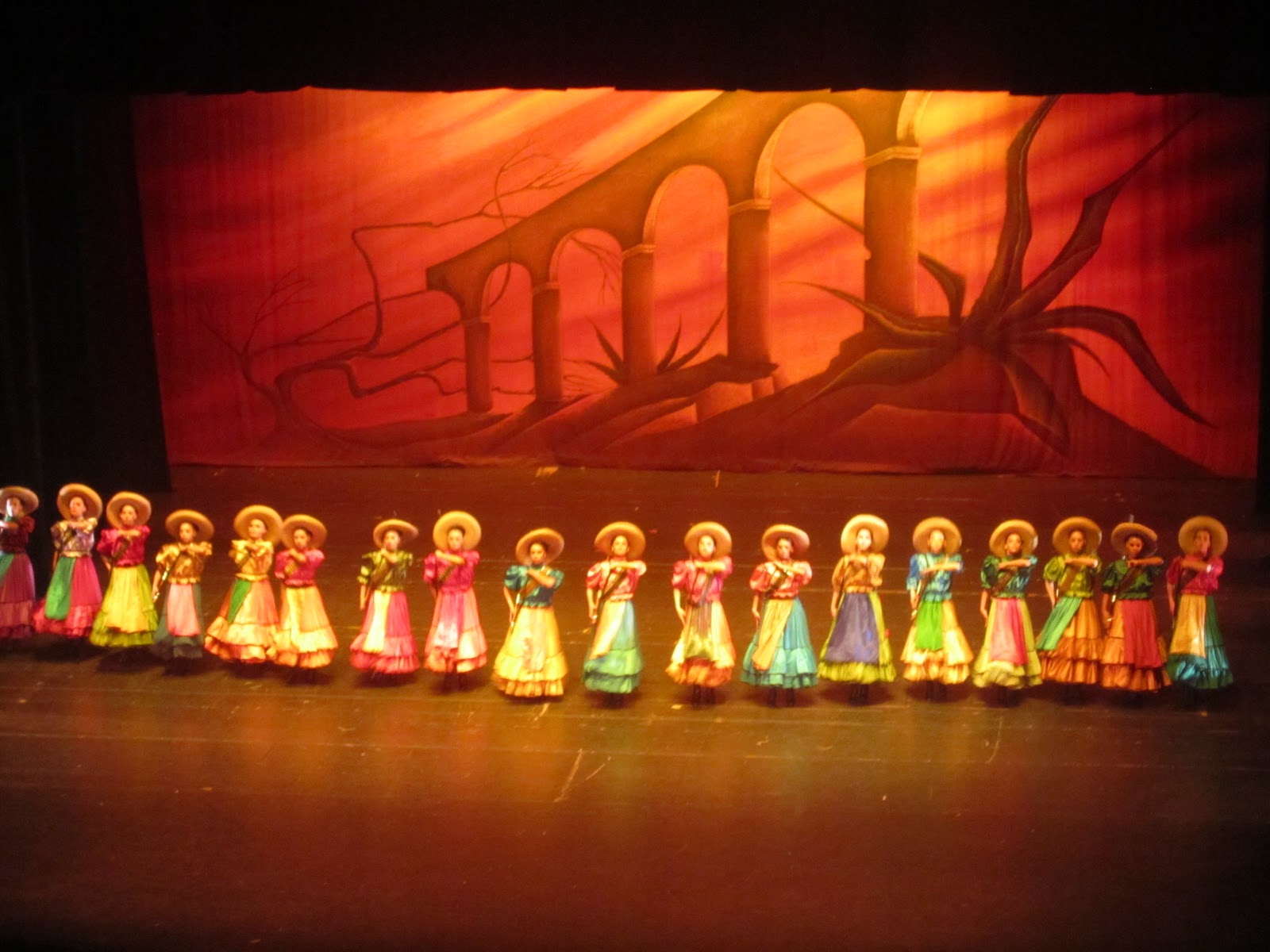
Women representing their role in the Mexican Revolution
On Sunday, March 13, The Globalization and Migration students as well as the Social Work students had the opportunity to visit Mexico City. We arrived in the morning to enter el Museo de Las Bellas Artes. We attended a Folkloric Ballet, which was truly incredible. Each dance had a story behind it, describing Prehispanic culture or an important figure or event in Mexico’s history. Not only was the ballet full of talent and beauty, but the stories behind them made it all the more interesting and special. My favorite dance was called “La Revolucion,” which had a series of dances with in the piece. The most moving part for me was when all of the female dancers were in one line with their rifles and bullets in hand. The movement and music together created a very strong image.

   
Male and female dancers representing
a regional culture
 After the ballet we were able to see some of the most important murals in Mexico by David Alvaro Siqueiros, Diego Rivera, and Jose Clemente Orozco. These three famous muralists’ work described the struggle of Mexican society after the Mexican Revolution. In many of the murals, the hard and tedious life of the worker was portrayed, as well as the overpowering affects of industrialization on the Mexican people.


After Bellas Artes, we went to Coyoacan and to el Museo de Frida Kahlo, La Casa Azul. We walked through her house to see a collection of permanent pieces that were very important in describing Frida’s life. We were able to see everything from her kitchen, to her and Diego Rivera’s bedroom, as well as her studio. Her studio especially moved me, seeing her wheelchair and paints left just as she would have kept them. I enjoyed learning more about her life and struggles as an artist and as a Mexican woman. We had free time in the neighborhood of Coyoacan where there were a variety of coffee shops, restaurants, and artisan markets. Our experience in Mexico City was a great learning experience and a lot of fun! I am sure I am not the only one who would like to spend more time in D.F.

Maren Daniels (Augsburg College ’13)

jueves, 10 de marzo de 2011

Al Campo or Bust

This week both the Migration and Globalization students and the Social Work students had the opportunity to experience life in rural Mexico. This particular town is located approximately an hour away from Cuernavaca. There were two main reasons the program decided to have us stay here with host families for three nights and four days. The first is that it was a good practice for our rapidly approaching longer term (6-week) urban home stay in Cuernavaca. The other is that many of the inhabitants of the community are still connected to their indigenous roots in some way.
 
The street outside where I lived


 However, just because we were there, that did not mean that we were on vacation! Granted, we did not have to sit in class and read books, but still, we participated in the Center for Global Education’s favorite teaching method—experiential learning… aka learning by experiencing. We went to a panel on immigration where we heard the very impressive but sad stories of two local men’s experiences in traveling to and working in the United States and returning home again.

The next day, my birthday (March 1st), we got to experience something completely new and exciting. We all received a Temazcal and a Limpia. These are two traditions that have been passed down from the original indigenous people who lived in the area. A Temazcal is essentially a sweat. You have to crawl into this oven-like cavern where you will sit in complete darkness with about eight other people. Once inside, we were instructed to remain silent while asking the Gods for clarity on something in our lives, or that they help resolve a problem of ours. While we are doing this, a person (who is familiar with the tradition) is waving palm leaves around in order to continually increase the temperature. Finally, after a half hour, we exited the cavern and were asked to wrap ourselves in sheets that they gave to us and lay on the ground to let our body temperatures readjust.

A statue of of the god Quetzalcoatl in the town square
After receiving our Temazcal, we went to go see community leaders for our Limpias. A Limpia is another type of cleansing tradition. In this case, the community leader took leaves from a particular type of plant that grows in the area and an egg into one of his hands and ran them together all over our bodies. The point of this is to extract the negative energies from our bodies with the egg and plant. After this process, he cracked the egg into a glass of water and was able to read the contents. He told us things about our lives and how we are as people in general. He also told us about some life struggles we may have had in our lives thus far. I know it sounds a little out there, but he was completely accurate with my reading. I could not believe it!

Well, after an interesting and busy four days in the campo (country) getting to know a different piece of Mexico, a little about some indigenous traditions and perspectives on life, and living with a family, we returned back to Cuernavaca, where, for better or for worse, we felt more comfortable. We missed not only our houses, but being home. Before going out to the community, I know that I had some preconceived ideas about what I was going to see. What do you think those things were? What do you think the reality was? Would you be willing to put yourself in a similar situation? Well, if you ever have the opportunity to do so, I would strongly suggest it.

Jordan Freking (Williams College ’12)

lunes, 21 de febrero de 2011

Visit to Maquiladora: Globalization at Work

Continuing our study of globalization issues, this week we had the opportunity to visit a maquiladora. Maquiladoras are production factories that work with clothing products, electronics and other materials that can be similarly assembled. Since the implementation of NAFTA (the North American Free Trade Agreement) in 1994, more and more U.S. companies have used maquiladoras for their production – often sending the raw materials to Mexico and then receiving the finished goods back in the U.S. However, U.S. companies are not the only ones to utilize this means of production and unfortunately, many take on sweatshop labor conditions. Long hours, lack of benefits, fear of organizing and unsafe work conditions are characteristics of some maquilas.
We visited a maquila that produces high-end swimwear – and were constantly reminded by this fact by huge photos of models in swimsuits placed around the facility. The feeling among us walking around could be described as “uncomfortable.” We had a difficult time distinguishing whether or not we should “feel bad” for watching people work – I certainly wouldn´t appreciate people (especially foreigners) walking around analyzing the work I was doing. However, that does not necessarily mean that people were unappreciative of our presence or unhappy with their work. These are not judgments we can make for ourselves, they would have to result from conversations with the workers. Unfortunately, we were only allowed conversations with managers and supervisors – both men, while the majority of workers were women. These class, gender and racial (the color of the managers was in general noticeably lighter) separations are those found in many of our interactions and help to continue the alienation we experience on either side of these divides.

Regardless of our personal feelings regarding the visit (and we all certainly had different ones), I think it is important to see the means of production in order to fully understand globalization or transnational capitalism. To read about NAFTA in a book is different to see Mexican workers cutting and sewing imported fabric that will then be re-imported back to the U.S. And confronting some uncomfortable situations of this reality is important and many of us don´t do it as much as we should. It helps us to question ourselves and challenge the structures within which we live.

One question that remains with me is: How is it possible that the women and men working
in the maquila we visited will probably receive weekly wages that equal less than the amount that a woman in the United States will pay for just one bathing suit? How is this possible? What are the solutions? To find out, we will keep learning, keep discussing, keep sharing our experiences and opinions, and hopefully be closer to some answers when we are finished. Maybe we won´t, but then again, maybe we will.

-Anna Loizeaux

miércoles, 16 de febrero de 2011

The Pain of Racism and Classism

We have been very busy this past week including a day visit to a nearby pueblo (village). People in this area have ancestors from many different ingenious cultures; however, the man we spoke to is from the Nahua community. He started off by stating he is indigenous and proud to be so. In Mexico and around the world, this can be a revolutionary statement.

I received a lot of information from the speaker and upon reflection, I feel strongly about what this man spoke of regarding the racism that still exists in Mexico today. I can relate in many ways, having seen the racism back home in my community in the United States. I struggle to understand and comprehend why people are so cruel towards one another on the basis of their race and this alone. After hearing this speaker discuss the various racisms amongst people of Mexico, I found this issue even more disheartening. In the U.S., people of Mexican descent are can be referred to as “Hispanic,” “Mexican,” or “Mexican-American.” To the people of the U.S., we group many of these people together as one “race” yet here in Mexico, people are very aware of their culture and ethnic identity and the complexities that they entail.

After the conquest of the Spanish, to be indigenous was to be of a lower class. Furthermore, the Spaniards began to “mix” with the people of Mexico and people were born of a lighter skin color. This lighter skin color began to have a higher status than the darker skin color. The Spaniards were at the top of the pyramid regarding class and status, so the more one appeared like a Spaniard, the higher class they appeared in the social realm of Mexico. Light-skinned people, especially with blond hair and colored eyes are still tend to be of higher status and/or class. For this reason, indigenous people have been and continue to be oppressed and to fight to keep their culture alive for more than 300 years.

Many people have forgotten the indigenous or look past them, forgetting we are all of one being – the same, no matter what our skin color is. This racism and classism is still very much a problem in today’s reality. In Mexico, we see it much in the class and status of the color of one's skin-there are places in Mexico one is not able to go to or where people are unwelcome due to the color of their skin. This is much like the USA where there is much racism amongst and toward the various different ethnic groups, races as well as discrimination toward people of non-heterosexual identity, such as people who identify as GLBTQ.

Have we all forgotten that we were made the same, we all have red blood, like the man we spoke with said, and we were meant to be on Earth as one together? Why is there so much hate and pain amongst people who are “different” than one another?

-Amy Voigt (Augsburg College)

martes, 8 de febrero de 2011

Bringing in the New Year: Welcome to MG 2011!


Greetings friends, family and followers of Augsburg College´s the Center for Global Education and of our “Migration & Globalization: Engaging Our Communities” spring 2011 program! We are at the beginning of Week #3 and we can hardly believe it. So far the students have done scavenger hunts through the city, surveys of Cuernavaca´s extensive and impressive markets, have begun to hear personal stories of migration and have gotten introductions to Mexican and Pre-Hispanic history as well as contemporary politics and economic systems. Although the days are sometimes long, everyone has been critically engaged in the issues and working quite well as the living/learning community we strive to create. Our energy levels are up and we are so excited to see what the rest of the semester will bring!

Now let me give you a glimpse into a “normal” day here at CGE México…

Today, after Spanish class bright and early, we went with Professor Ann Lutterman-Aguilar to the Palacio de Cortés where we looked at a mural by famous Mexican artist, Diego Rivera. Rivera´s mural, “La conquista y revolución,” depicts, as the title implies, the Spanish Conquest of Mexico´s indigenous peoples as well as the Mexican Revolution beginning in 1910, which sought to overthrow the oligarchy and history of oppression that the Conquest started in 1519. Having three weeks behind them here in México, it was wonderful to see the students put to work the knowledge they have already acquired in analyzing the work – Bravo to them! As we have talked about as a group, in order to understand contemporary Mexican issues – particularly Migration and Globalization – it is crucial to understand Mexican history and how Mexicans view that history as a part of their everyday lives. The idea of “lucha” (struggle) – for freedom, for your family, for your land, for survival – is not a new concept in Mexican lives and is very much based in the histories Rivera touches on in this mural. In this way, it is so important that many MG students are studying both Mexican history as well as Mexican politics in order to understand the complexity of these issues as well as the ways they are interconnected.

Well, that´s all for now. I hope you are all well and continue to stay tuned for our weekly updates. Look for our reflections and our growth as the semester goes on!

-Anna Loizeaux (Intern - Graduate of Fordham College at Lincoln Center´s Class of 2010)